Understanding the Difference Between IE3, IE4 and IE5 Motors
Recently, we were asked to replace a failed motor.
As often happens, the conversation quickly shifted to the purchase price of the new motor. That’s understandable. A motor with a power rating of several dozen kilowatts is not an impulse purchase. So, what are the differences between IE3, IE4 and IE5 motors.
Still, we usually respond with the same question:
“How many hours does this motor run each year?”
And that’s often when the conversation changes.
Because the purchase price is rarely the biggest cost.
For many industrial motors, the purchase cost represents only a small fraction of what the motor will consume in electricity over its lifetime. In some cases, the energy bill can amount to several times the original purchase price.
The real cost is often hidden in the electricity the motor will consume over the next ten to fifteen years.
And that’s where we still see a lot of misunderstanding today.
The Most Expensive Motor Is Not Always the Most Costly
Many companies compare motors based primarily on the price shown on the quotation.
That seems logical.
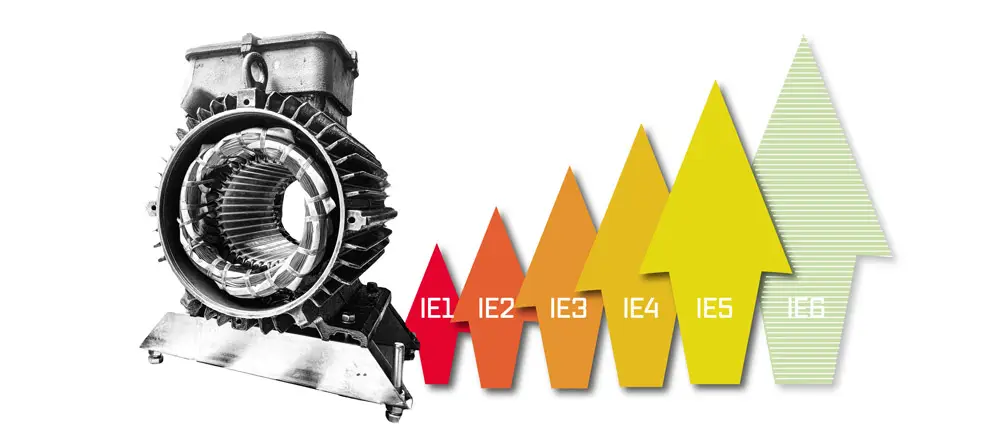
However, when a motor operates thousands of hours every year, the purchase price often represents only a small part of the total life cycle cost. An electric motor converts electrical energy into mechanical energy. During that process, part of the energy is inevitably lost as heat. The more efficient the motor, the lower those losses. To make motor efficiency easier to compare, international efficiency classes were introduced:
- IE1 = Standard Efficiency
- IE2 = High Efficiency
- IE3 = Premium Efficiency
- IE4 = Super Premium Efficiency
- IE5 = Ultra Premium Efficiency
Within Europe, IE1 motors and many IE2 motors have largely disappeared from new industrial applications.
Today, IE3 and IE4 are the most common choices. IE5 motors are becoming increasingly popular in applications where energy consumption plays a significant role.
What Is an IE3 Motor?
An IE3 motor is still considered the industrial standard today.
For many applications, it remains an excellent choice. It offers high efficiency, wide availability and a reasonable investment cost.
When a failed motor needs to be replaced, IE3 is often the starting point for comparison.
But that does not automatically mean it is the best option.
When Should You Choose an IE4 Motor?
With an IE4 motor, efficiency increases even further.
On paper, the difference may appear small. In practice, however, it can result in significant energy savings.
Especially when:
- the motor operates many hours per year;
- the load remains relatively constant;
- the motor’s power rating is higher;
- electricity costs are significant.
That is why IE4 motors are increasingly used for fans, pumps, compressors and conveyor systems that run almost continuously.
What Is an IE5 Motor?
IE5 is currently the highest efficiency class widely available for many industrial applications.
These motors often use advanced technologies such as permanent magnet motors or synchronous reluctance motors.
They achieve even higher efficiency levels and are particularly attractive when:
- installations operate for very high numbers of annual running hours;
- energy costs have a major impact on operating expenses;
- sustainability is an important objective;
- variable frequency drives (VFDs) are used.
The initial investment is higher than for a conventional IE3 motor, but in certain applications the payback period can be surprisingly short.
How Do You Calculate the Payback of a High-Efficiency Motor?
Let’s look at a motor commonly found in industrial applications:
- Power output: 30 kW
- Operating hours: 6,000 hours per year
- Load: 100%
- Electricity price: €0.20 per kWh
Assume an IE3 motor has an efficiency of approximately 93.6%, while a comparable IE4 motor achieves 95.5%.
IE3 Energy Consumption
Required electrical input:
30 kW ÷ 0.936 = 32.05 kW
Annual energy consumption:
32.05 × 6,000 = 192,300 kWh
Annual energy cost:
192,300 × €0.20 = €38,460
IE4 Energy Consumption
Required electrical input:
30 kW ÷ 0.955 = 31.41 kW
Annual energy consumption:
31.41 × 6,000 = 188,460 kWh
Annual energy cost:
188,460 × €0.20 = €37,692
The Difference
Annual saving:
€768
Over fifteen years:
€11,520
And that’s for just one motor.
In a production environment with dozens of motors, those figures quickly become much more significant.
IE3, IE4 or IE5 at a Glance
- IE3 remains an excellent standard choice for many industrial applications.
- IE4 becomes increasingly attractive when a motor runs many hours per year.
- IE5 is best suited for applications where maximum energy efficiency is a priority.
- The right choice always depends on power rating, load profile, operating hours and energy costs.
- Not every older motor needs to be replaced. In many cases, motor repair or overhaul remains the most sensible option.
- The industry is already looking ahead to future efficiency classes such as IE6, although these developments are still mainly found in technical and standardisation discussions.
When Should You Replace a Motor and When Should You Repair It?
This may be the most important question of all.
Installing a new IE4 or IE5 motor is not always the right choice.
Sometimes the existing motor can be repaired and continue operating reliably for many years.
In other situations, a simple calculation clearly shows that a modern high-efficiency motor will pay for itself within a reasonable period of time.
That’s why at AMR we don’t look only at the failed motor itself.
We evaluate the complete picture:
- power rating;
- load conditions;
- operating hours;
- energy costs;
- expected service life;
- repair costs;
- investment costs.
Only then can a well-founded decision be made.
The Cheapest Motor Does Not Exist
The motor with the lowest purchase price often appears to be the most economical option.
But when that motor runs thousands of hours per year for the next fifteen years, the electricity bill often tells a very different story.
That is why we prefer to look at the total cost over the entire life cycle.
After all, you’re not buying a motor for today.
You’re buying a motor for the next ten to fifteen years.
Today, discussions are centred around IE3, IE4 and increasingly IE5 motors. At the same time, manufacturers are already exploring IE6 and even higher efficiency levels.
That doesn’t mean every installation should be replaced tomorrow.
It does mean that energy consumption will continue to play an increasingly important role when deciding whether to repair, replace or invest in a different motor technology.
And that’s when efficiency suddenly becomes a lot more interesting.
#TheDriveSpecialists