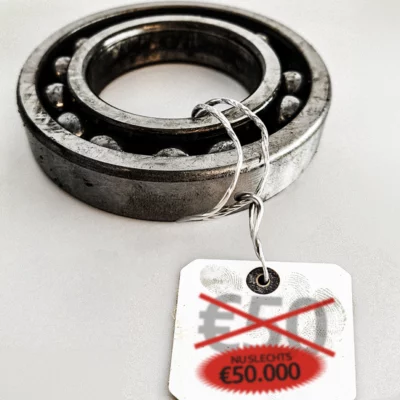
Replacing a bearing may cost only €50.
Nobody loses sleep over that.
Yet we regularly see situations where such an inexpensive component ultimately costs thousands of euros. Not because the bearing itself is expensive, but because few companies calculate the true cost of what happens when that bearing brings a critical installation to a standstill.
An electric motor driving a fan. A pump that is essential to production. A conveyor that suddenly stops.
The moment one of these drives fails, costs start adding up much faster than most companies expect.
Production stops. Operators are left waiting. Deliveries are delayed. The maintenance team drops everything to solve the problem. Spare parts may need to be ordered urgently. And if the breakdown lasts longer than expected, pressure quickly builds from production and planning departments.
On paper, it is a €50 component failure.
In reality, it can mean hours of lost production.
What many companies underestimate is that failures rarely happen overnight. A bearing does not suddenly decide to fail on a Monday morning. In most cases, warning signs have been present for weeks or even months.
- The motor starts vibrating slightly more.
- A fan gradually becomes unbalanced.
- A misalignment creates additional stress on the drive.
Small deviations that seem harmless at first, yet slowly develop into much larger problems.
The challenge is that these signals are often impossible to detect during a routine visual inspection. Nothing appears wrong. Until the installation suddenly stops.
That is usually when someone says: "The motor was running perfectly fine last week."
In reality, the machine had often been warning of a developing issue for quite some time.
That is why vibration analysis has become an increasingly valuable tool in modern maintenance strategies. Not because companies enjoy collecting data, but because vibration is often one of the earliest indicators that a bearing, coupling, fan or drive system is beginning to deteriorate.
By identifying those signals early, maintenance can be planned instead of performed under pressure during an unexpected breakdown.
That difference may seem small, but the impact can be enormous.
Planned maintenance is typically faster, less expensive and causes far less production loss than an emergency intervention.
And downtime is not the only risk.
A damaged bearing or overloaded motor often generates additional heat. In certain environments this can lead to smoke development or even fire hazards. What starts as a simple mechanical issue can quickly evolve into a serious safety concern.
At AMR Service, we see every day how small deviations become major problems when they go unnoticed. Fortunately, we also see the opposite: companies that identify developing defects in time thanks to vibration analysis and avoid costly downtime.
That is ultimately what predictive maintenance is all about.
- Not more measurements.
- Not more reports.
- Simply fewer surprises.
Because the most expensive bearing is usually not the one that needs replacing.
It is the bearing nobody saw coming.